 Add to Chrome
 Add to Firefox
 Add to Edge
MonoDuo: Using One Robot Arm to Learn Bimanual Policies
May 28, 2026
Bimanual coordination is essential for many real-world manipulation tasks, yet learning bimanual robot policies is limited by the scarcity of bimanual robots and datasets. Single-arm robots, however, are widely available in research labs. Can we leverage them to train bimanual robot policies? We present MonoDuo, a framework for learning bimanual manipulation policies using single-arm robot demonstrations paired with human collaboration. MonoDuo collects data by teleoperating a single-arm robot to perform one side of a bimanual task while a human performs the other, then swapping roles to cover both sides. RGB-D observations from a wrist-mounted and fixed camera are augmented into synthetic demonstrations for target bimanual robots using state-of-the-art hand pose estimation, image and point cloud segmentation, and inpainting. These synthetic demonstrations, grounded in real robot kinematics, are used to train bimanual policies. We evaluate MonoDuo on five tasks: box lifting, backpack packing, cloth folding, jacket zipping, and plate handover. Compared to approaches relying solely on human bimanual videos, MonoDuo enables zero-shot deployment on unseen bimanual robot configurations, achieving success rates up to 70%. With only 25 target robot demonstrations, few-shot finetuning further boosts success rates by 65-70% over training from scratch, demonstrating MonoDuo's effectiveness in efficiently transferring knowledge from single-arm robot data to bimanual robot policies.

Beyond Binary: Sim-to-Real Dexterous Manipulation with Physics-Grounded Contact Representation
May 27, 2026A primary bottleneck in contact-rich manipulation is the difficulty of collecting real-world data. Sim-to-real reinforcement learning offers a scalable alternative, but the simulation-reality gap prevents information-dense modalities like touch from being effectively used. Existing sim-to-real methods often mitigate this gap by simplifying tactile data into coarse low-dimensional features -- sacrificing the richness required for complex manipulation. In this work, we introduce Center-of-Pressure (CoP), an effective tactile representation grounded in physical principles that preserves dense contact information while maintaining robustness for sim-to-real transfer. To support this representation, we propose a sensor calibration scheme based on differentiable dynamics, enabling the estimation of taxel orientations without requiring ground-truth force measurements. We evaluate CoP on two blind, challenging contact-rich manipulation tasks: peg-in-hole insertion and ball balancing. Across both tasks, policies conditioned on CoP achieve zero-shot sim-to-real transfer on a multi-fingered hand, and outperform both coarse binary-contact and raw-taxel baselines. Analysis of learned policy states further suggests that CoP-conditioned policies encode task-relevant physical properties, such as object mass, as an emergent byproduct of control.
How to Peel with a Knife: Aligning Fine-Grained Manipulation with Human Preference
Mar 03, 2026Many essential manipulation tasks - such as food preparation, surgery, and craftsmanship - remain intractable for autonomous robots. These tasks are characterized not only by contact-rich, force-sensitive dynamics, but also by their "implicit" success criteria: unlike pick-and-place, task quality in these domains is continuous and subjective (e.g. how well a potato is peeled), making quantitative evaluation and reward engineering difficult. We present a learning framework for such tasks, using peeling with a knife as a representative example. Our approach follows a two-stage pipeline: first, we learn a robust initial policy via force-aware data collection and imitation learning, enabling generalization across object variations; second, we refine the policy through preference-based finetuning using a learned reward model that combines quantitative task metrics with qualitative human feedback, aligning policy behavior with human notions of task quality. Using only 50-200 peeling trajectories, our system achieves over 90% average success rates on challenging produce including cucumbers, apples, and potatoes, with performance improving by up to 40% through preference-based finetuning. Remarkably, policies trained on a single produce category exhibit strong zero-shot generalization to unseen in-category instances and to out-of-distribution produce from different categories while maintaining over 90% success rates.
Coordinated Humanoid Manipulation with Choice Policies
Dec 31, 2025Humanoid robots hold great promise for operating in human-centric environments, yet achieving robust whole-body coordination across the head, hands, and legs remains a major challenge. We present a system that combines a modular teleoperation interface with a scalable learning framework to address this problem. Our teleoperation design decomposes humanoid control into intuitive submodules, which include hand-eye coordination, grasp primitives, arm end-effector tracking, and locomotion. This modularity allows us to collect high-quality demonstrations efficiently. Building on this, we introduce Choice Policy, an imitation learning approach that generates multiple candidate actions and learns to score them. This architecture enables both fast inference and effective modeling of multimodal behaviors. We validate our approach on two real-world tasks: dishwasher loading and whole-body loco-manipulation for whiteboard wiping. Experiments show that Choice Policy significantly outperforms diffusion policies and standard behavior cloning. Furthermore, our results indicate that hand-eye coordination is critical for success in long-horizon tasks. Our work demonstrates a practical path toward scalable data collection and learning for coordinated humanoid manipulation in unstructured environments.
Emergent Active Perception and Dexterity of Simulated Humanoids from Visual Reinforcement Learning
May 18, 2025Human behavior is fundamentally shaped by visual perception -- our ability to interact with the world depends on actively gathering relevant information and adapting our movements accordingly. Behaviors like searching for objects, reaching, and hand-eye coordination naturally emerge from the structure of our sensory system. Inspired by these principles, we introduce Perceptive Dexterous Control (PDC), a framework for vision-driven dexterous whole-body control with simulated humanoids. PDC operates solely on egocentric vision for task specification, enabling object search, target placement, and skill selection through visual cues, without relying on privileged state information (e.g., 3D object positions and geometries). This perception-as-interface paradigm enables learning a single policy to perform multiple household tasks, including reaching, grasping, placing, and articulated object manipulation. We also show that training from scratch with reinforcement learning can produce emergent behaviors such as active search. These results demonstrate how vision-driven control and complex tasks induce human-like behaviors and can serve as the key ingredients in closing the perception-action loop for animation, robotics, and embodied AI.
Sim-to-Real Reinforcement Learning for Vision-Based Dexterous Manipulation on Humanoids
Feb 27, 2025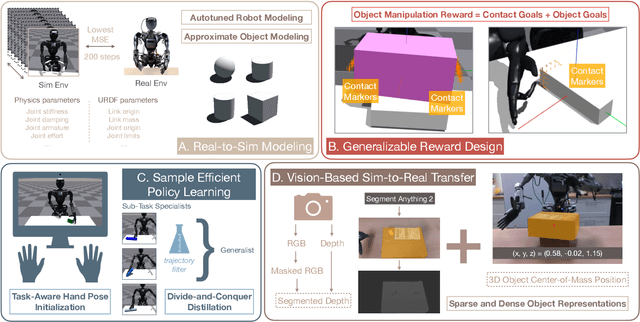
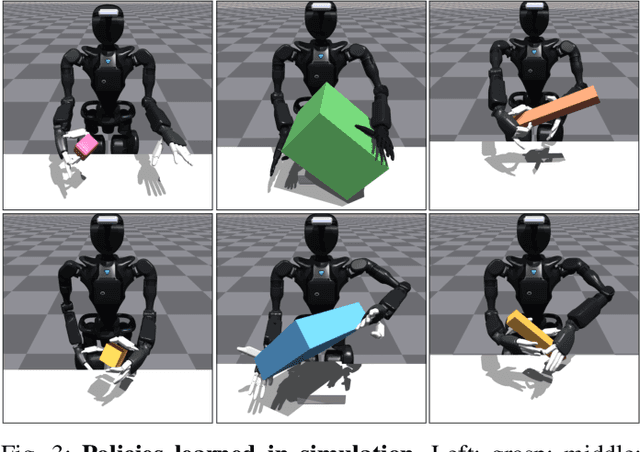
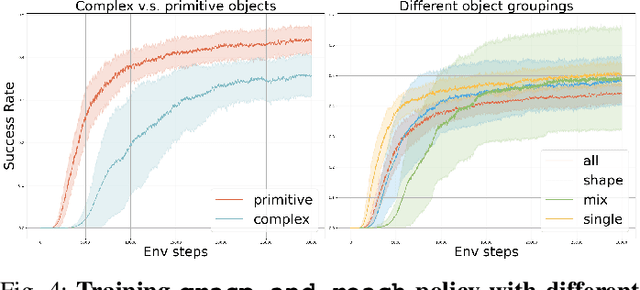
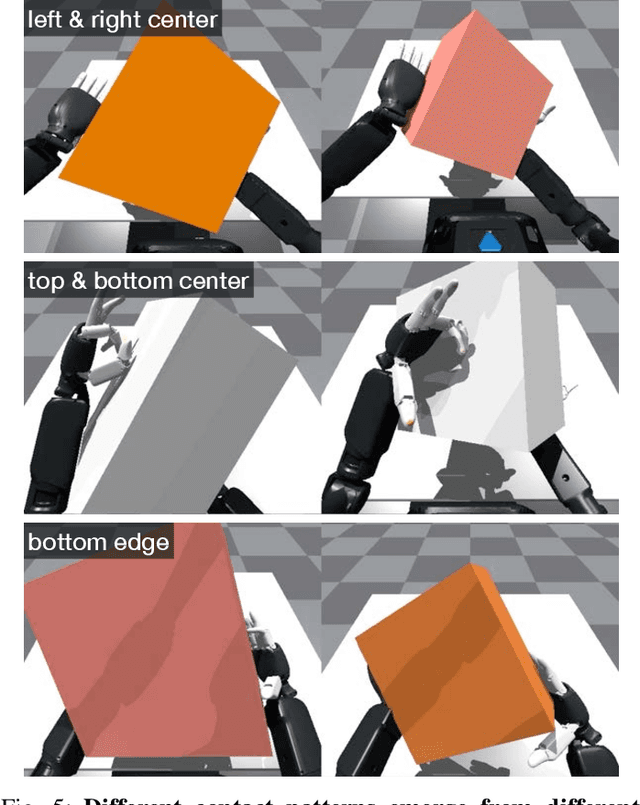
Reinforcement learning has delivered promising results in achieving human- or even superhuman-level capabilities across diverse problem domains, but success in dexterous robot manipulation remains limited. This work investigates the key challenges in applying reinforcement learning to solve a collection of contact-rich manipulation tasks on a humanoid embodiment. We introduce novel techniques to overcome the identified challenges with empirical validation. Our main contributions include an automated real-to-sim tuning module that brings the simulated environment closer to the real world, a generalized reward design scheme that simplifies reward engineering for long-horizon contact-rich manipulation tasks, a divide-and-conquer distillation process that improves the sample efficiency of hard-exploration problems while maintaining sim-to-real performance, and a mixture of sparse and dense object representations to bridge the sim-to-real perception gap. We show promising results on three humanoid dexterous manipulation tasks, with ablation studies on each technique. Our work presents a successful approach to learning humanoid dexterous manipulation using sim-to-real reinforcement learning, achieving robust generalization and high performance without the need for human demonstration.
HOVER: Versatile Neural Whole-Body Controller for Humanoid Robots
Oct 28, 2024


Humanoid whole-body control requires adapting to diverse tasks such as navigation, loco-manipulation, and tabletop manipulation, each demanding a different mode of control. For example, navigation relies on root velocity tracking, while tabletop manipulation prioritizes upper-body joint angle tracking. Existing approaches typically train individual policies tailored to a specific command space, limiting their transferability across modes. We present the key insight that full-body kinematic motion imitation can serve as a common abstraction for all these tasks and provide general-purpose motor skills for learning multiple modes of whole-body control. Building on this, we propose HOVER (Humanoid Versatile Controller), a multi-mode policy distillation framework that consolidates diverse control modes into a unified policy. HOVER enables seamless transitions between control modes while preserving the distinct advantages of each, offering a robust and scalable solution for humanoid control across a wide range of modes. By eliminating the need for policy retraining for each control mode, our approach improves efficiency and flexibility for future humanoid applications.
Learning Visuotactile Skills with Two Multifingered Hands
Apr 25, 2024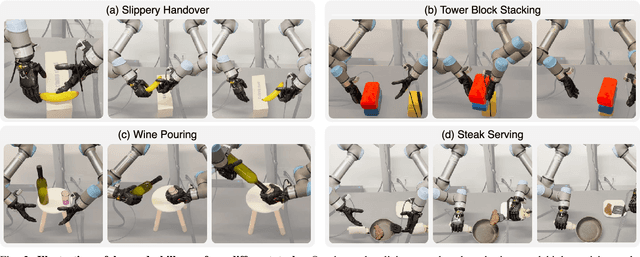
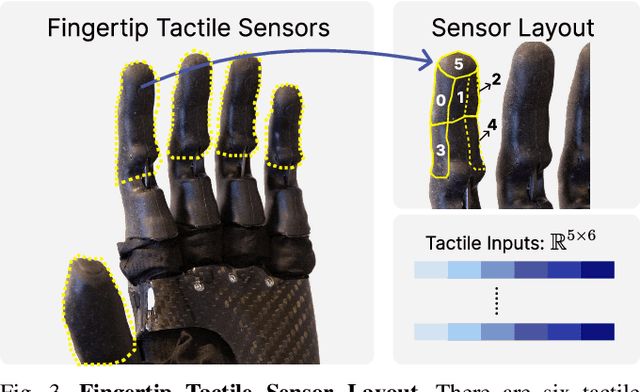
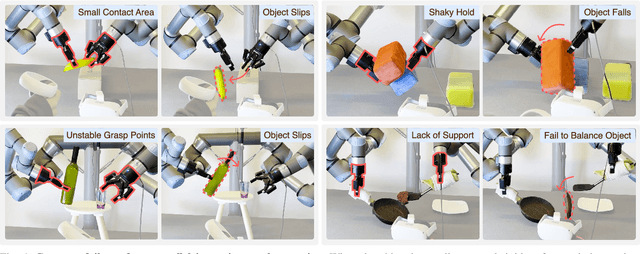
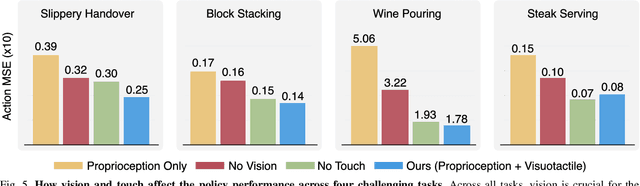
Aiming to replicate human-like dexterity, perceptual experiences, and motion patterns, we explore learning from human demonstrations using a bimanual system with multifingered hands and visuotactile data. Two significant challenges exist: the lack of an affordable and accessible teleoperation system suitable for a dual-arm setup with multifingered hands, and the scarcity of multifingered hand hardware equipped with touch sensing. To tackle the first challenge, we develop HATO, a low-cost hands-arms teleoperation system that leverages off-the-shelf electronics, complemented with a software suite that enables efficient data collection; the comprehensive software suite also supports multimodal data processing, scalable policy learning, and smooth policy deployment. To tackle the latter challenge, we introduce a novel hardware adaptation by repurposing two prosthetic hands equipped with touch sensors for research. Using visuotactile data collected from our system, we learn skills to complete long-horizon, high-precision tasks which are difficult to achieve without multifingered dexterity and touch feedback. Furthermore, we empirically investigate the effects of dataset size, sensing modality, and visual input preprocessing on policy learning. Our results mark a promising step forward in bimanual multifingered manipulation from visuotactile data. Videos, code, and datasets can be found at https://toruowo.github.io/hato/ .
Twisting Lids Off with Two Hands
Mar 04, 2024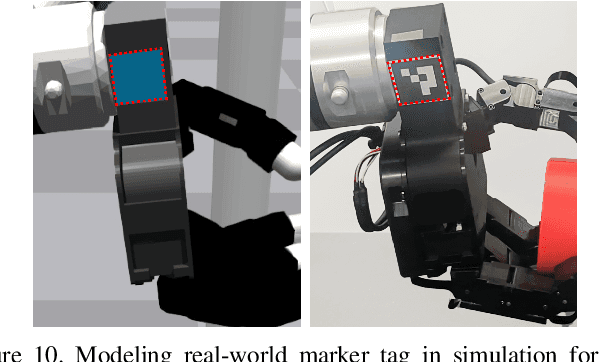
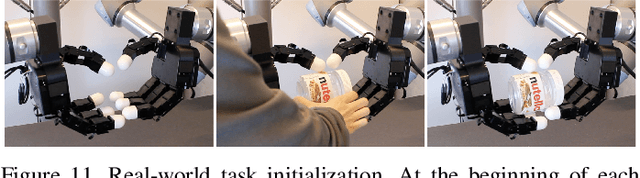
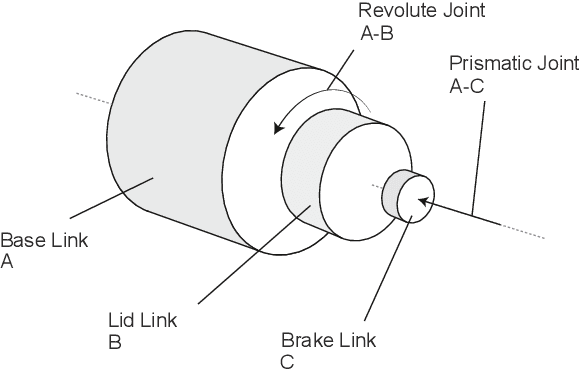
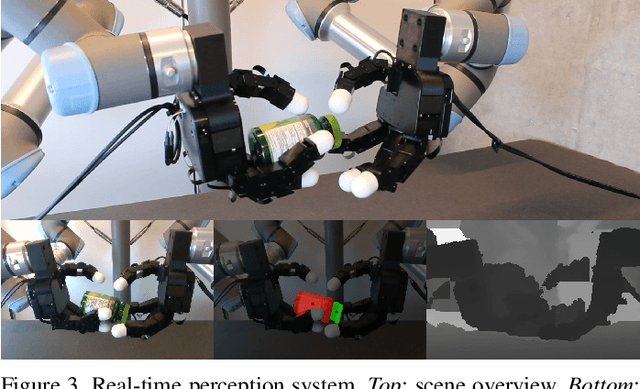
Manipulating objects with two multi-fingered hands has been a long-standing challenge in robotics, attributed to the contact-rich nature of many manipulation tasks and the complexity inherent in coordinating a high-dimensional bimanual system. In this work, we consider the problem of twisting lids of various bottle-like objects with two hands, and demonstrate that policies trained in simulation using deep reinforcement learning can be effectively transferred to the real world. With novel engineering insights into physical modeling, real-time perception, and reward design, the policy demonstrates generalization capabilities across a diverse set of unseen objects, showcasing dynamic and dexterous behaviors. Our findings serve as compelling evidence that deep reinforcement learning combined with sim-to-real transfer remains a promising approach for addressing manipulation problems of unprecedented complexity.
MIMEx: Intrinsic Rewards from Masked Input Modeling
May 15, 2023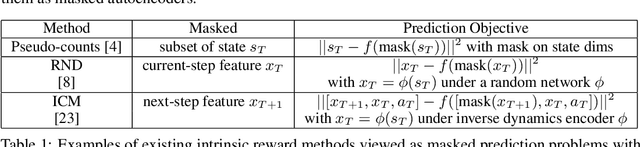
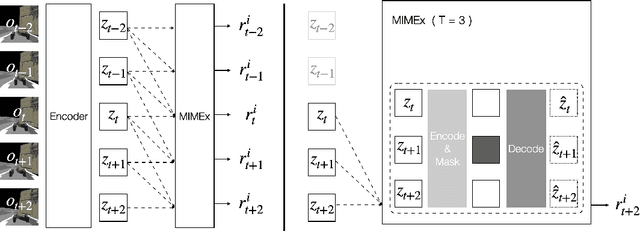
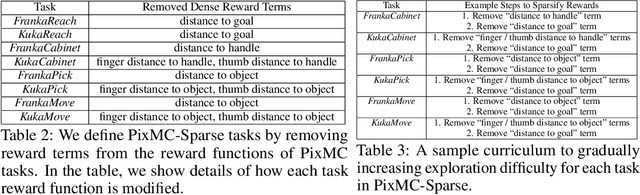
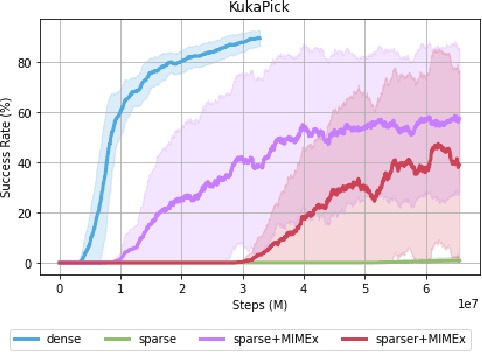
Exploring in environments with high-dimensional observations is hard. One promising approach for exploration is to use intrinsic rewards, which often boils down to estimating "novelty" of states, transitions, or trajectories with deep networks. Prior works have shown that conditional prediction objectives such as masked autoencoding can be seen as stochastic estimation of pseudo-likelihood. We show how this perspective naturally leads to a unified view on existing intrinsic reward approaches: they are special cases of conditional prediction, where the estimation of novelty can be seen as pseudo-likelihood estimation with different mask distributions. From this view, we propose a general framework for deriving intrinsic rewards -- Masked Input Modeling for Exploration (MIMEx) -- where the mask distribution can be flexibly tuned to control the difficulty of the underlying conditional prediction task. We demonstrate that MIMEx can achieve superior results when compared against competitive baselines on a suite of challenging sparse-reward visuomotor tasks.